Director Squires Just Killed Seven TikTok IPRs — And Patent Owners Should Be Paying Attention
- Erick Robinson
- Apr 3
- 3 min read

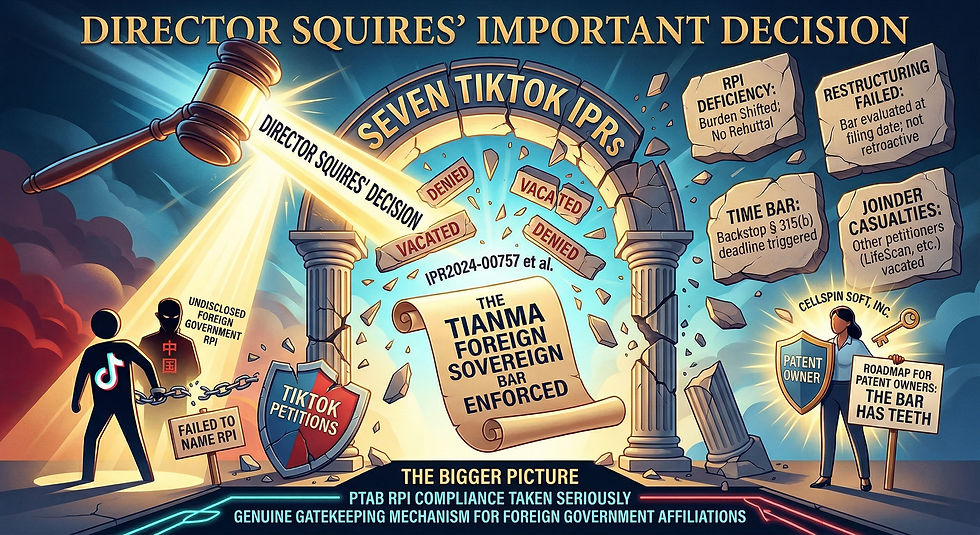
On March 30, 2026, Director Squires issued an important decision in TikTok Inc. v. CellSpin Soft, Inc., IPR2024-00757 et al. (Paper 42), vacating institution across seven inter partes reviews and denying all petitions.
The reason? TikTok failed to name a foreign government as a real party in interest — and under the Director's own precedential Tianma framework, that's a death sentence for an IPR.
Here's why this matters.
The Setup
CellSpin Soft sued TikTok in October 2023. TikTok filed seven IPR petitions between April 1–5, 2024, challenging patents across the CellSpin portfolio. Institution was granted.
CellSpin moved to terminate, arguing two things: (1) that the Chinese government — through its well-documented relationship with TikTok's parent company — was an undisclosed real party in interest, and (2) that under Return Mail, Inc. v. USPS, 587 U.S. 618 (2019), a foreign government is not a "person" eligible to petition for IPR.
The Board denied the motion. Director Squires initiated sua sponte review.
The Kill Shot: Tianma Applied
On March 18, 2026, Director Squires issued the precedential Tianma Microelectronics v. LG Display decision, holding that foreign governments cannot be "persons" under the AIA and are therefore barred from participating as petitioners or RPIs in IPR proceedings. Twelve days later, he applied Tianma directly to TikTok.
The analysis was straightforward:
CellSpin presented ample evidence that a foreign government was an RPI — articles, reports, a DHS Business Advisory, and U.S. court decisions.
That evidence was sufficient to put the RPI question into dispute.
Under Worlds Inc. v. Bungie and Corning Optical, the burden then shifted to TikTok to prove it had named all RPIs and that none were foreign governments.
TikTok was authorized to introduce rebuttal evidence. It introduced none.
Game over.

The Restructuring Didn't Help
TikTok pointed to its newly announced Joint Venture (TikTok USDS Joint Venture LLC, announced January 22, 2026) as a structural fix. Director Squires was unmoved: the foreign sovereign bar is evaluated as of the petition filing date, not as of the date a company restructures.
Even worse for TikTok: it filed updated mandatory notices on February 2, 2026, identifying the Joint Venture as an RPI. But accepting that date as the effective filing date would trigger the one-year time bar under § 315(b) — CellSpin sued in October 2023, meaning April 2024 was the deadline. February 2026 was nearly two years too late.
The restructuring was a double-edged sword: it implicitly conceded the RPI deficiency while simultaneously running headlong into the time bar.
The Joinder Casualties
LifeScan, Senseonics, and Ascensia had joined as petitioners in three of the seven IPRs. When the underlying institutions were vacated, their joinder was vacated with them. The Board was directed to evaluate their independently filed petitions (IPR2025-00102, -00103, -00104) on their own merits.
Why Patent Owners Should Care
This decision is the first major real-world application of the Tianma foreign sovereign bar, and it landed on one of the highest-profile technology companies in the world. The implications are significant:
The foreign sovereign bar has teeth. Director Squires didn't just articulate the rule in Tianma — he enforced it immediately and decisively.
The evidentiary burden is manageable. CellSpin didn't need a smoking gun. Public reporting, government advisories, and court decisions were enough to shift the burden. Patent owners facing IPRs from companies with documented foreign government ties now have a clear playbook.
Corporate restructuring is not a retroactive cure. The RPI analysis is locked to the petition filing date. Restructuring after the fact doesn't cleanse a defective petition — it just highlights the problem.
The time bar is a backstop. Even if a petitioner tries to "fix" its RPI disclosures mid-proceeding, the updated filing date will often trigger § 315(b). This creates a structural trap that benefits patent owners.
Joinder is only as strong as the underlying petition. Joined parties should carefully evaluate the lead petitioner's RPI compliance before hitching their wagon to someone else's case.
The Bigger Picture
Director Squires continues to reshape PTAB practice through an aggressive exercise of Director Review authority. Between Tianma, YMTC, the re-precedentialization of Corning Optical, and now this decision, the message to patent owners is clear: the Office is taking RPI compliance seriously, and companies with foreign government affiliations face a genuine gatekeeping mechanism at institution.
For patent owners who have been on the receiving end of IPR petitions from companies with opaque or foreign-government-linked ownership structures, this decision is a roadmap. The evidence doesn't need to be perfect. It needs to be enough to shift the burden. And if the petitioner doesn't respond? The Director just showed you what happens.


Comments